
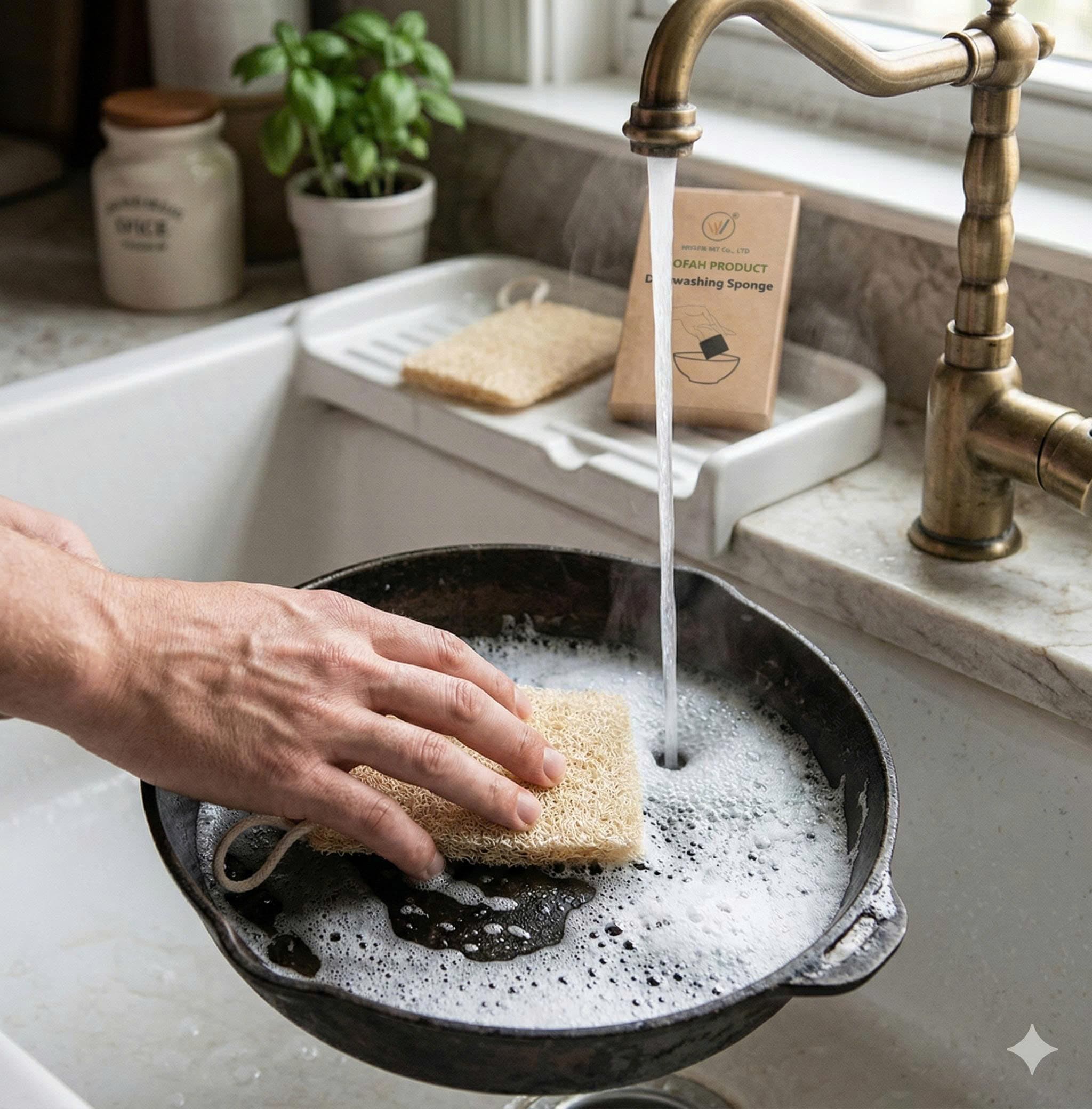
How Long Does a Loofah Last and When to Replace It
A natural loofah does not last forever.
And it should not.
Loofah is a plant-based fibre.
That is why people choose it as a plastic-free alternative for bath, body care, and kitchen cleaning.
But because it is natural, it has a real product lifecycle.
The question is not only:
“How long does a loofah last?”
The better question is:
“How do I know when my loofah is still clean, strong, and safe to use?”
The answer depends on how often you use it, how well you rinse it, how fast it dries, and how the loofah was processed before it reached your home.
In this guide, we will explain how long a loofah usually lasts, what affects its durability, when to replace it, and how to choose a better-quality loofah from the beginning.
How long does a loofah last?
In normal use, a natural loofah can last several weeks.
For bath use, many users replace it after around 3–6 weeks.
For kitchen use, replacement may be faster because the loofah comes into contact with grease, food residue, soap, and repeated rinsing.
But there is no perfect number for every user.
A loofah used once a week in a dry bathroom will last longer than a loofah used twice a day in a humid shower.
A kitchen loofah used only for light dish cleaning will last longer than one used for heavy scrubbing.
So instead of following only a fixed timeline, look at the condition of the fibre.
A natural loofah should be replaced when it no longer looks, smells, or feels clean.
What affects how long a loofah lasts?
Several factors decide the lifespan of a loofah.
1. Fibre maturity
Not all loofah fibre is the same.
A mature loofah has a stronger internal fibre network.
The structure is usually more stable, more elastic, and less likely to break apart quickly.
Immature or low-density loofah may feel soft at first, but it can collapse, tear, or become flat after repeated use.
For buyers, fibre maturity matters because it affects the customer experience.
For consumers, it affects how long the loofah feels useful.
2. Drying quality before production
A good loofah starts before cutting or sewing.
Raw loofah must be properly dried.
If the raw material still holds moisture, the final product may have a higher risk of smell, dark spots, mold, or weak fibre.
That is why professional loofah production should include dryness inspection, mold checking, colour checking, smell checking, and fibre strength checking before the product is finished.
A loofah that is not dried well at the source may not last well in the bathroom or kitchen.
3. Daily rinsing
Soap, body wash, dead skin, food residue, and grease can stay inside the fibre.
If these residues are not rinsed out, they shorten the product’s useful life.
After each use, rinse the loofah under clean water.
Squeeze it gently.
Do not leave residue trapped inside the structure.
This simple habit can help the loofah stay cleaner for longer.
4. Airflow after use
A loofah needs airflow.
If it is left flat on a wet sink, inside a closed shower corner, or stored in a container, moisture stays longer.
That increases the risk of mold and odor.
The best habit is to hang the loofah after use.
A hanging loop is not only for convenience.
It helps the product dry faster.
5. Bathroom or kitchen humidity
Environment matters.
A loofah used in a dry, ventilated bathroom will usually last longer.
A loofah kept in a damp bathroom with no airflow may develop smell or dark spots faster.
In the kitchen, constant contact with water and food residue can shorten the life of the sponge.
If your bathroom or kitchen is humid, drying habits become even more important.
When should you replace a loofah?
Replace your loofah when you notice any of these signs.
1. It smells musty
Smell is one of the earliest warning signs.
If the loofah smells damp, sour, musty, or unpleasant after rinsing, it is time to replace it.
Natural loofah should have a mild, clean, plant-like character.
It should not smell like mold.
2. Dark spots appear
Small natural colour differences are normal.
But black, grey, or dark spots that spread or do not rinse away can be a warning sign.
If you see this, replace the loofah.
Do not continue using a loofah that looks contaminated.
3. The fibre becomes weak
A good loofah should keep its structure during normal use.
Replace it when the fibre becomes too soft, breaks apart, tears easily, or loses its scrubbing function.
Weak fibre means the product has reached the end of its useful life.
4. It stays wet for too long
If your loofah does not dry between uses, the risk increases.
Sometimes the issue is not the loofah itself but the storage place.
Try hanging it in a better-ventilated area.
If it still stays damp or smells bad, replace it.
5. It feels slimy
A slimy texture is a clear signal that the loofah should not be used anymore.
Rinse it once.
If the texture does not return to normal, discard it.
How to make your loofah last longer
A natural loofah lasts longer when it is cared for properly.
Rinse thoroughly
After each use, rinse the loofah until the water runs clean.
This removes soap, body wash, skin residue, or food particles.
Squeeze gently
Remove excess water.
Do not twist too hard, especially with sewn bath gloves or body scrubbers.
Gentle pressure is enough.
Hang to dry
Do not leave it lying flat.
Hang it on a hook, rack, or dry wall area.
Airflow is one of the best ways to reduce moisture.
Keep it outside the wettest area
If possible, do not keep your loofah directly under the shower stream.
Move it to a drier part of the bathroom after use.
Let it dry completely
A loofah should have enough time to dry before the next use.
If you use loofah daily, consider having two pieces and rotating them.
This gives each one more drying time.
Is a longer-lasting loofah always better?
Not always.
A natural loofah should be durable, but it is still a hygiene product.
If a loofah lasts too long because it is made from synthetic material or treated with heavy chemicals, that may not fit the reason people choose natural loofah in the first place.
The goal is balance.
A good loofah should be:
Strong enough for repeated use.
Soft enough after wetting.
Quick to rinse.
Easy to dry.
Free from strange smell.
Natural in colour and texture.
Replaceable without creating plastic waste.
Durability matters, but hygiene matters more.
What retailers and Amazon sellers should know
For retailers, loofah durability directly affects customer trust.
If customers complain that the loofah falls apart too quickly, the product feels cheap.
If customers complain about mold or smell, the brand feels unsafe.
If the product lasts reasonably well and dries properly, customers are more likely to reorder.
For Amazon sellers, this affects reviews.
Common negative review risks include:
Too small.
Too thin.
Falls apart quickly.
Smells bad.
Does not dry well.
Feels too rough or too weak.
This is why supplier selection matters.
A loofah supplier should not only provide a low price.
They should be able to explain:
How raw material is selected.
How fibre strength is checked.
How moisture is controlled.
How mold risk is reduced.
How the product is dried before packing.
How packaging supports storage and presentation.
A durable loofah starts with a controlled process.
How to choose a better loofah from the beginning
When buying a loofah, look for these signs:
Natural fibre structure.
No strange chemical smell.
Clean colour.
Firm but flexible texture.
Hanging loop or easy-dry design.
Clear care instructions.
Packaging that does not trap moisture.
For private-label buyers, ask your supplier for more than photos.
Ask for sample testing.
Test the loofah dry and wet.
Check how it expands.
Check how it dries.
Check how it feels after multiple uses.
Check whether the fibre breaks or stays stable.
This is how you avoid selling a product that looks good in photos but performs poorly after use.
Final answer: how long does a loofah last?
A natural loofah usually lasts several weeks, depending on use and care.
But the best time to replace it is not based only on the calendar.
Replace it when it smells musty.
Replace it when dark spots appear.
Replace it when the fibre becomes weak.
Replace it when it stays damp.
Replace it when it no longer feels clean.
The key to longer use is simple:
Rinse well.
Squeeze gently.
Hang dry.
Store in airflow.
Choose mature, well-dried, mold-checked fibre from the start.
A loofah is not just a sponge.
It is a natural fibre product.
When it is made well and used correctly, it can be a clean, practical, plastic-free part of your bath or kitchen routine.
Looking for a more durable, mature-fibre loofah? Explore our natural loofah bath and kitchen range designed for better drying, daily use, and retail-ready eco presentation.